 EN
EN 
Explanation - Level, Decibel, and Power Ratings
Short & Sweet - Volume, Sound Pressure Level, Level Loss:
• +6dB to +10dB corresponds roughly to twice the perceived volume level, depending on personal perception and the tone/sound.
Therefore, +12dB to +20dB corresponds roughly to four to eight times the perceived volume.
• +6dB corresponds electrically to twice the volume, +12dB to 4 times the volume.
• To achieve +3dB, twice the electrical power is required; for a 10dB increase, roughly 10 times the power is needed.
• Doubling the number of speakers yields +3dB due to twice the cone surface area and +3dB due to twice the power handling, resulting in a maximum increase of +6dB.
An actual increase in sound pressure level is only obtained in the region where the spacing is smaller than one wavelength.
• A loss of -6dB occurs per doubling of distance when calculated in the far field; in the near field, it drops by -3dB per doubling of distance.
(Various designs, arrays, etc. can extend the near field, such as larger line arrays or wave formers!)
• In Germany, a maximum level of 99dB Leq applies at the loudest point officially accessible to a listener.
For example, at the beginning of the dance floor/stage area. More details can be found here. However, this is A-weighted, meaning L(A)eq (Important!) Link
• Per solid angle, you get +6dB sound pressure level or +3dB sound power level (approx. <300Hz, depending on baffle size & distance).
This means that with floor placement, we gain +6dB in the bass range, moved against a wall yields +12dB,
and pushed into a corner yields +18dB. (Full-space, half-space, quarter-space, eighth-space, etc.)
Be careful with positioning and wall distances due to comb filter effects,
so always place them as close to the wall as possible! (Rough rule of thumb: <1.5m or over 4m).
Depending on the room size, below frequency x (as soon as the wavelength is larger than the room), a so-called
pressure chamber effect occurs (where room resonances cease to exist); we all know this effect primarily from inside a car.
{slider title="Auszug vom Forenuser Hiandreas" class="blue solid"}
• Bei Spannung gilt: Pegel in dB: L = 20 · log (Spannungsverhältnis)
Pegel +6 dB = doppelte Spannung
Pegel +12 dB = vierfache Spannung
Pegel +20 dB = zehnfache Spannung
Pegel +40 dB = hundertfache Spannung
Höchst selten interessiert in der Tonstudiotechnik wirklich die Leistung.
Vergiss daher die Frage nach Leistungsverstärkung!
• Bei Leistung gilt: Pegel in dB: L = 10 · log (Leistungsverhältnis)
Pegel +3 dB = doppelte Leistung
Pegel +6 dB = vierfache Leistung
Pegel +10 dB = zehnfache Leistung
Pegel +20 dB = hundertfache Leistung
• Elektrische Leistung P = P0 * 10 (LP/10)W
• Elektrischer Leistungspegel LP = 10 log10 (P/P0)dB
1W = 0dB
2W = 3.0102999566398116 dB
4W = 6.020599913279623 dB
8W = 9.030899869919434 db
16W = 12.041199826559247 dB
32W = 15.051499783199057 dB
64W = 18.061799739838868 dB
128W = 21.072099696478677 dB
256W = 24.082399653118493 dB
512W = 27.092699609758302 dB
1024W = 30.102999566398115 dB
10W = 10dB
100W = 20dB
1000W = 30dB
10.000W = 40dB {/sliders}
Sound Pressure, Efficiency & Sound Pressure Level:
Certain terms are frequently mixed up, so here are a few concise explanations:
• Sensitivity / Characteristic Sound Pressure Level is the average sound pressure level across a wide frequency range under constant voltage and at a defined distance,
often at 1W/1m or V/m. It is sometimes also referred to as sensitivity or efficiency (which is ambiguous). Unit symbol: dB (decibel)
• Sound Pressure Level (SPL) is expressed in dB and describes the magnitude of an acoustic event.
It is sometimes also called sound level (ambiguous!) or simply level. Unit symbol: dB (decibel)
• Sound Pressure (or alternating sound pressure) is a sound field quantity and describes the pressure fluctuations in (e.g.) the air
caused by the propagation of sound. Unit symbol: Pascal (Pa)
• (Acoustic) Efficiency is often confused with the sensitivity rating. It is a dimensionless quantity and describes
the ratio of useful acoustic power output to the supplied electrical power input, but it can be converted into % or sensitivity ratings.
Formula symbol: Eta. Unit symbol: "None" or percent.
An efficiency of 0.01 or 1% corresponds to a characteristic sound pressure level of 92dB.
• Sound Level is a colloquial shorthand term for the level of an acoustic quantity,
and can describe the sound pressure level, sound power level, or sound intensity level.
Nominal Sound Pressure Level of the Speaker?!
• Check the data sheets carefully to see how and where measurements were taken.
• Some manufacturers rate their speaker based on its highest peak point.
Example: The overall response averages 97dB, but above 8kHz the frequency response exhibits a narrow-band rise to 102dB;
nevertheless, the speaker is specified as 102dB in the data sheet.
• Especially with subwoofers, it makes no sense to specify the level above their actual operating range (typically 40-120Hz).
• Others use an average value. If the average is 97dB, but the lowest point is at 95dB and the highest at 103dB
(since no speaker is absolutely linear), the average value stated by the manufacturer might be 99dB, which is again 2dB too high.
• It is best to look directly at the measurement charts and determine the average level yourself.
• Often you will see the level specified at 2.83V, which however only corresponds to one watt into an 8-Ohm load;
for a 4-Ohm load, measurements would need to be taken at 2V to represent 1W. Nevertheless, some 4-Ohm speakers are specified with their level at 2.83V
(e.g., 95dB 2.83V/1m), which already corresponds to twice the supplied power!
This is not incorrect, but it can easily be misinterpreted or overlooked.
Data sheets with other distance specifications have also been spotted (95dB/0.5m), but fortunately, this is very rare.
Typically, the characteristic sound pressure level is specified at one watt of power at a distance of one meter.
So "1W/1m", or alternatively "2.83V/1m", although in the case of the latter, the impedance should be included,
e.g., 2V/1m/4 Ohms.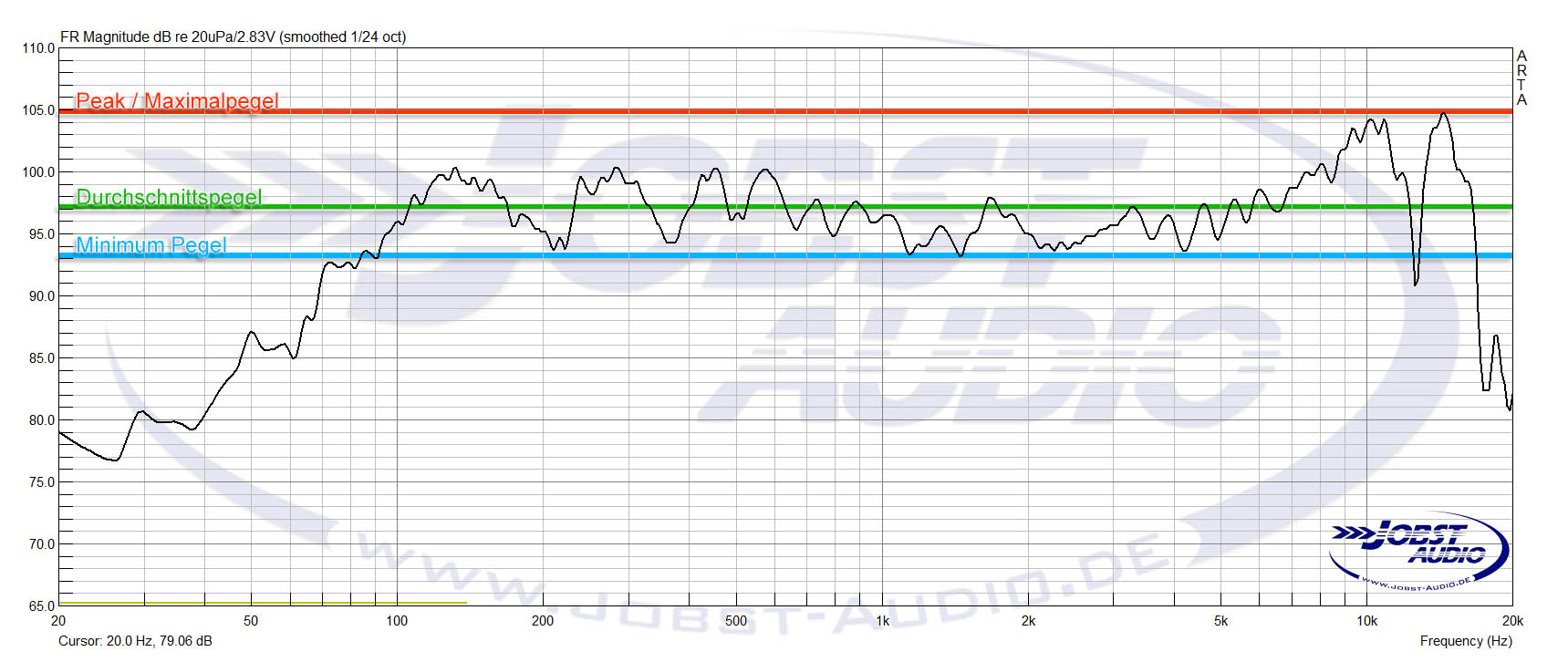
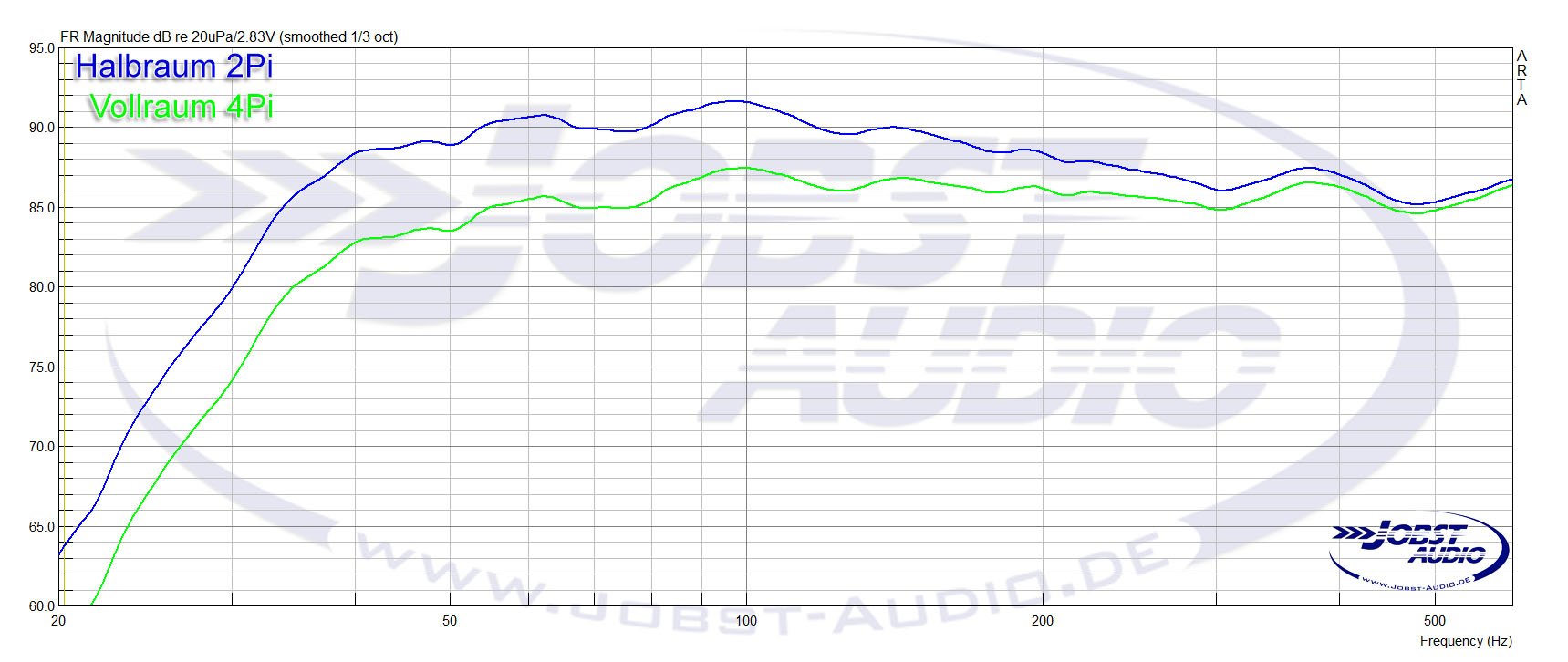
• A similar situation applies to subwoofers, or the low-end frequency response of full-range speakers. Here, one must
pay close attention to whether the measurements were taken or specified in full-space (4pi fullspace) or in half-space (2pi halfspace).
In half-space, the bass range displays a whopping 6dB higher level!
(Half-space corresponds to floor placement)
It is not an isolated incident that top cabinets are specified with half-space levels, but then
6dB is incorrectly calculated across the entire speaker bandwidth. This is naturally incorrect,
as the solid angle restriction only impacts the bass range up to roughly 300-400 Hz;
above that, a top cabinet operates in half-space anyway (depending on the baffle size).
Naturally, this specification also impacts the listed lower cutoff frequencies,
meaning that a subwoofer or full-range top cabinet will play "deeper" in half-space than in full-space.
(Depending on how data and average values are determined)
Maximum SPL of the Speaker:
• Personally, I consider this specification quite unnecessary, but unfortunately, it is far too often the only value people (especially beginners) look at!
• There are huge differences here, as the maximum sound pressure level can be determined or specified in various ways:
-> Personally, I determine the level at 1W/1m and extrapolate it based on the RMS power handling. This gets quite close to the actual maximum level,
minus power compression, for example (though that would need to be measured precisely).
-> Frequently, the peak efficiency of the speaker (the highest point on the response curve at 1W, see above) combined with the maximum power handling of the drivers is used
and simply calculated upwards, which easily adds at least 3dB to the spec sheet.
-> Or it is even calculated up to the peak power handling, i.e., what the speaker could theoretically handle for just a few milliseconds from cold,
which adds at least 6dB to the data sheet.
(If program or continuous power handling is additionally listed, the max SPL on the spec sheet is usually even 9dB higher!)
A speaker with the following specs:
94dB (1 W/1 m)
4 Ohms
200W RMS, 400W max, and 800W peak.
Theoretically yields a maximum level of 117dB (Level at RMS load)
A program level of 120dB (max. power)
A peak level of 123dB. (Absolute maximum for a few ms)
However, if this 4-Ohm speaker is specified at 2.83V/1m instead of 1W/1m, the 94dB quickly turns into a solid 97dB, because 2.83V corresponds to 2W into a 4-Ohm load.
Instead of stating the average level, the peak value of 102dB (1W) is chosen, turning the 94dB speaker into a 105dB speaker in no time!
Extrapolated to peak power using peak values, this results in the following specs:
Sensitivity: 105dB 2.83V/1m (or 102dB 1W/1m)
Max SPL: 131dB (usually even 134dB at peak power)
And there you have a wonderful spec sheet with values 10dB higher, without anything being invented or faked!
We will not cover "PMPO" and the like, as these represent completely
invented values or exist somewhere in the nanosecond range, making them extremely impractical.
Note on Distortion & Max SPL:
In some cases, the maximum level is determined via distortion limits; this is how certain magazines do it, for instance.
The max SPL is then specified at 10% THD, for example.
Personally, I find this impractical because THD includes H2, H3, H4, and so on.
The non-intrusive H2 distortion of loudspeakers, especially tweeters, is often quite high,
whereas the intrusive H3 distortion remains low.
This results in a high measured THD, which forces a low specified maximum level,
even though the speaker is far from actually "sounding" distorted and still has plenty of headroom.
A nearly correct method would be to drive the speaker at its RMS power for a while until it gets quite warm,
allowing power compression to fully set in, and then measure the level.
However, this is quite cumbersome and not 100% practical, as our music is known to be dynamic (high crest factor),
meaning that in real-world scenarios, we generally generate much less heat buildup.
In short, there are quite a lot of ways to determine, calculate, or measure the maximum sound pressure level,
but in my opinion, very few of them are genuinely meaningful in practice.
Anyone who has read and understood all of this will also understand why and how I specify the maximum level
(as well as other values, like the 1W/1m sensitivity) for loudspeakers.
That means quite honestly, without artificially enhanced values. Power compression, crest factor, etc., can be roughly deducted by yourself.
(Which has admittedly earned me quite a few questions as to why speaker XY "only" delivers 96dB,
while the one from YXZ provides 104dB, despite being the same size and supposedly offering massive bass... etc.)
Power compression can fluctuate between 1dB and over 6dB, depending on the music material,
the driver's application (sub, low, mid, high), and its overall quality.
As a rough rule of thumb, you could anticipate around -3 to -4dB at full throttle for mid-tier top cabinets.
So, how loud is it actually?
• When I listen really loudly in my living room, I have nearly 90dB(A) at the listening position, which is quite a lot,
since I almost have to shout at the person next to me.
• Looking at the calculations above, we can determine that my speaker needs to deliver a clean 102dB,
so that I can "enjoy" my 90dB at a 4m listening distance.
(With A-weighting, the bass can/may/must naturally be quite a bit louder. See the links above for more details).
• At a public event, we are "only" allowed a maximum of 99dBA, so what should be done?
The speaker needs to be moved a few meters back, away from the people, so that the
drop in level over distance is minimized/extended.
Furthermore, the speakers should be flown or mounted as high as possible, which greatly benefits even coverage,
and therefore speech intelligibility and overall sound quality.
However, this requires the speaker to be capable of higher output, since it is positioned further away from the audience.
An alternative (or additional) solution would be a line array, delay line(s), intelligent placement of narrow-dispersion tops, etc.
Our speaker is mounted at a height of 3 meters and is about 3 meters away from the first listener, naturally angled/precisely aimed, as it should be.
Thus, the distance to the first listener is roughly 4 meters. To hit them with 99dB, our speaker must produce a level of 111dB at 1 meter.
People at a distance of 8 meters (i.e., 4m past the start of the dance floor) will then only receive 93dB.
If our speakers were placed right at the very front next to the stage, directly in front of the first listeners, they would only need 1–2 watts to deliver their allowed 99dB.
However, listeners at a distance of 4 meters (from the start of the dance floor/stage area) would then only receive 87dB instead of 93dB!
In short, speakers should always be placed as high or as far away from the first listener as possible, but they must be capable of providing more output to compensate.
Do you like this article?


- Details
-
Also available:

- Parent Category: Articles
- Hits: 54