 EN
EN 
Placement & Directivity in the Bass Range
Left-Right:
• Often the only option for smaller events due to venue constraints and stage designs.
• One stack of subwoofers on each side of the stage (usually with the top cabinets stacked on top).
Advantages:
+ Easy to set up
+ Stereo setup possible
+ Simple controlling (e.g., for CSA, see below)
+ Top cabinets are quickly or easily placed at the correct height.
+ Cardioid behavior can be achieved with just one additional subwoofer and controller channel (CSA).
+ Stacks of 3–4 subwoofers or more can be controlled (each subwoofer separately) to vary vertical directivity,
or to attenuate upward acoustic radiation.
Disadvantages:
- So-called "bass alleys / comb filtering" (number of interference nulls increases with frequency)
- Sound is not directional
- Does not "throw" or carry the sound very far.
- No attenuation of the sound pressure level behind the subwoofers.
- Top cabinets are often just placed straight on top due to the stacking feet recesses,
without any horizontal or vertical tilt.


44Hz, 125Hz
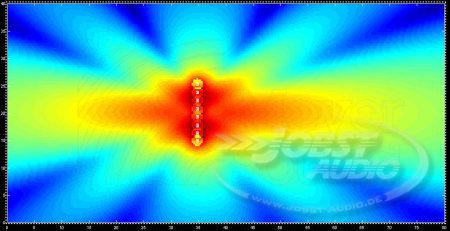
Spaced Subwoofer Array / Straight Line
• Subwoofers placed side-by-side, but with physical gaps between the individual cabinets.
• A spaced array narrows the horizontal coverage compared to a single mono stack.
• The more subwoofers used, the more directional the coverage becomes.
Advantages:
+ CSA (Cardioid) can be utilized
+ Curved/Delayed setups can be used
+ Easy to set up
+ Requires only one controller channel
+ Requires only one amplifier channel
+ High acoustic "throw" / distance coverage
+ No cancellation nulls within the critical frequency range
Disadvantages:
- Spaced arrays produce cancellation nulls above a certain frequency (depending on the gap distance between subs), similar to L-R setups.
- Little to no rear attenuation, and if any, only at higher frequencies; instead, it narrows sideways depending on the array size (especially compared to L-R).
- Requires space and a certain minimum width in front of the stage.
- No stereo bass split.
Mono-Cluster Setup
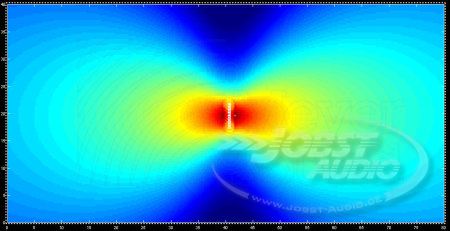
• A mono cluster creates an omnidirectional sphere rather than a directional lobe (compared to a spaced array) but carries further than an L-R setup.
• All subwoofers are placed tightly together in a single row or block.
Advantages:
+ CSA (Cardioid) can be utilized
+ Curved/Delayed setups can be used
+ Easy to set up
+ Requires only one controller channel
+ Requires only one amplifier channel
+ "Throws" further than an L-R setup
+ No cancellation nulls within the critical frequency range
+ No side comb filtering compared to a spaced array, and requires less width.
Disadvantages:
- No cancellation to the rear, but attenuation to the sides depending on the size of the cluster.
- Requires space and width in front of the stage.
- No stereo bass split.
- Does not carry as far as a spaced array, but offers more homogenous dispersion.
- To completely control directivity, we would need a cluster size of roughly 10x10 meters (>40Hz).
CSA - Cardioid Subwoofer Array:
• Easy to implement and works exceptionally well.
• Can be used with L-R setups, mono clusters, or spaced arrays (partially applicable to End-Fire as well).
• One out of three subwoofers is completely reversed (facing backwards), inverted, and delayed.
(Caution: Flipping the phase by 180° on the controller often yields a different result than true signal inversion!)
(Delay: Physical depth of the subwoofer [acoustic centers] + approx. 10-20cm)
(The level should also be adjusted, approx. + 3dB)
Advantages:
+ Excellent bass cancellation to the rear
+ Requires only one additional controller path and amplifier channel
+ The reversed subwoofer still adds roughly 1.5dB (instead of 3dB) to the total output
+ Coverage pattern can be slightly shaped via the delay settings (cardioid, hypercardioid...)
Disadvantages:
- Requires an additional controller channel
- Looks a bit odd because the rear side of one subwoofer is visible
- Cable routing can be inconvenient.
- Requires an additional amplifier channel.


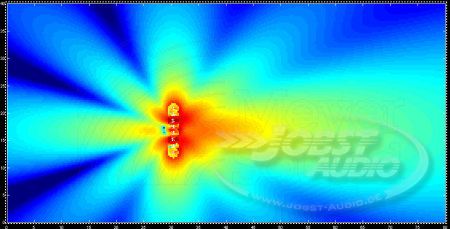
Single stack of 3 subs, L-R setup, spaced array
Directional / Curved Bass-Array
• Subwoofers are arranged in a physical arc, delayed towards the outer edges, or both.
Advantages:
+ Rearward acoustic radiation is well attenuated
+ Coverage can be heavily shaped by delay times, as can the rear attenuation
+ No loss in acoustic output level
Disadvantages:
- Setup becomes quite large
- Requires a massive amount of amplifier channels
- Requires a massive amount of controller channels
- Must be calculated precisely
Info:
• Can also be achieved without separate controller paths by physically staggering the placement of the subwoofers
+ Requires only a single amplifier and DSP channel
- Requires a massive amount of space
- Must be positioned with absolute accuracy
- Any adjustments always involve heavy lifting and reshuffling
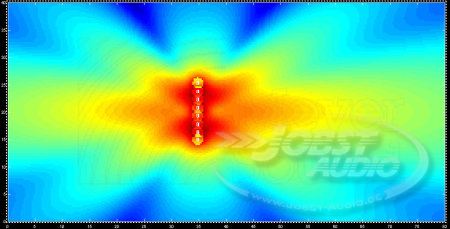
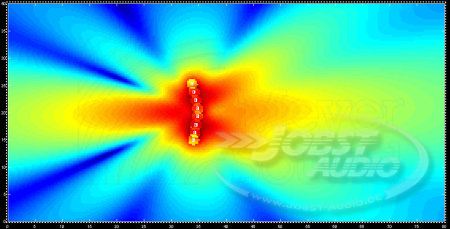
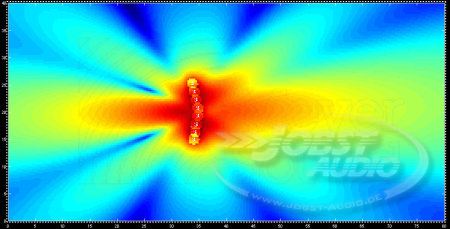
Spaced array delayed, spaced array curved, spaced array delayed and curved
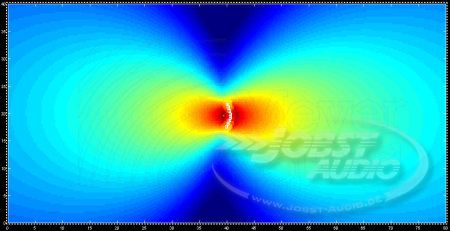
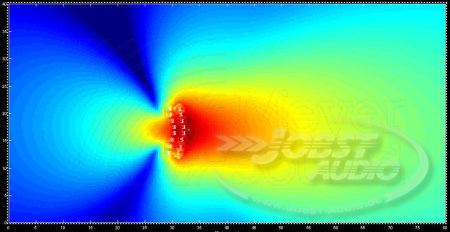
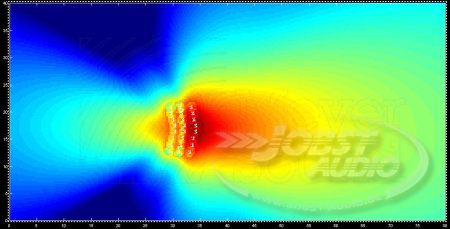
Mono Curved, Endfire curved, Endfire 3 Rows Curved
EFA - End Fire Array
• A highly discussed topic on the internet! ;-)
• Subwoofers are set up similarly to a spaced array, but with additional identical stacks placed directly behind them; the front rows are then delayed.
Advantages:
+ Rearward sound is well attenuated if the delay is set shorter, even when physically curved
+ Gain in total SPL due to the additional subwoofers
+ Highly directional and homogenous dispersion pattern
+ Can partially be combined with L-R setups (inheriting its usual disadvantages)
Disadvantages:
- Requires a lot of physical depth between the stage and the audience
- Requires a large number of subwoofer cabinets
- Requires one dedicated DSP + amplifier channel per subwoofer row/array
- Should preferably be built with 3 or 4 rows of subwoofers rather than just 2
- The more arrays used (rows behind the front line), the more the rear cardioid pattern tends to degrade at higher frequencies
- The more arrays used, the narrower the forward coverage angle becomes at higher frequencies
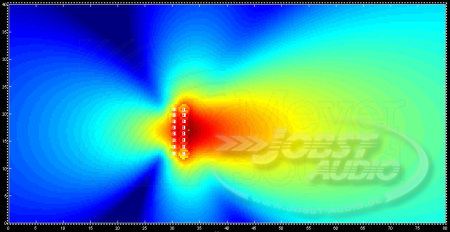
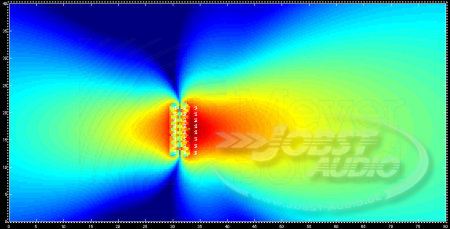
Endfire 2 Rows, Endfire 3 Rows (precise delay -> not ideal)
Endfire 2 Rows Curved, Endfire 3 Rows Curved
Do you like this article?


- Details
-
Also available:

- Parent Category: Articles
- Hits: 56